
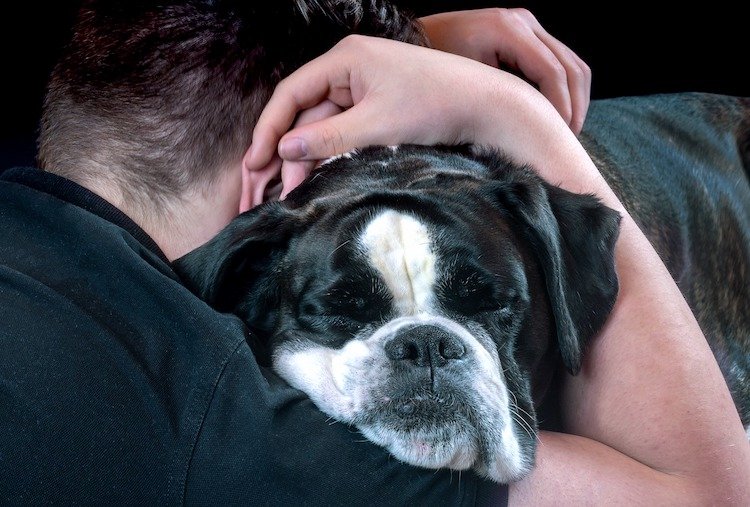
 What happens to my pet if I catch COVID-19? Photo: Myriams-Fotos
In a matter of weeks, the world has changed beyond anything any of us have seen before.
Quarantines, supplies, food rationing and fear are the name of the game right now during the COVID-19 coronavirus pandemic.
For those of us with pets, that fear hits just a little bit harder as we wonder: What happens to my pet if I catch COVID-19 and become seriously ill?
It’s a good idea to put together a plan for your pet in any disaster-type situation. Whether it’s a hurricane or a global pandemic, your pet will need someone to care for them in the event that you cannot do so.
Please take some time right now to do just that.
Put Together Your Pet Emergency Supply Kit
The very first component is a pet first-aid kit.
The Federal Emergency Management Agency (FEMA) advises that you discuss this with your veterinarian if your pet has any specific medical needs.
That said, “most kits should include cotton bandage rolls, bandage tape and scissors; antibiotic ointment; flea and tick prevention; latex gloves, isopropyl alcohol and saline solution,” FEMA says.
Your emergency supplies should also include these essential items:
- 2-week supply of your pet’s food (If you use canned foods, try to get those with pop tops. Dry food should be stored in an airtight, waterproof container.)
- Disposable litter trays
- Litter and paper towels
- Trash bags
- Feeding and water bowls
- Extra collars, leashes and harnesses
- Waterproof container with 2-week supply of any medicine your pet requires, labeled with instructions and dosages
- Photocopies of medical records, rabies certificate, microchip number, etc.
- Current photo of you and your pet together
“Remember, food and medications need to be rotated out of your emergency kit,” advises the ASPCA, “otherwise they may go bad or become useless.”
In the event that you become hospitalized and unable to care for your pet, having all the necessities organized together ensures that the person taking over their care will have everything they need.
Your kit should be customized to your pet. You can include certain toys, chews, bedding, crates and anything else that will make your pet more comfortable and see that their needs are met. Make sure your pets are wearing up-to-date, visible identification (collar and ID tag) at all times.
The American Veterinary Medical Association (AVMA) shares the following relevant COVID-19 FAQs:
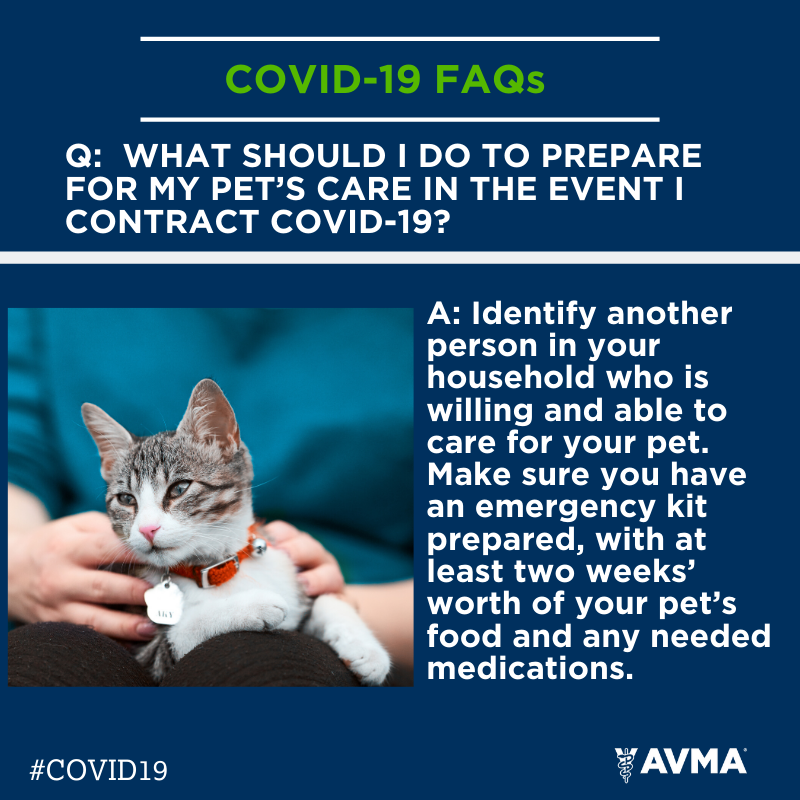

Designate an Alternative Caregiver
According to the U.S. Centers for Disease Control and Prevention (CDC), “It is not believed pets can be infected with COVID-19, nor is it believed they can spread the disease. However, pets may ‘temporarily harbor the virus’ on the coat or other areas of the pet’s body.” (For more on pets and the coronavirus, see our vet-written article.)
“If you are diagnosed with COVID-19, allow a family member to care for your pets,” the CDC advises. “If no one is available, maintain a safe distance from your pet and frequently wash your hands before and after contact with your pet.”
But what happens if you have to go to the hospital — and you don’t have anyone else who lives in the household with you?
Is there a trusted friend, neighbor or even organization that could temporarily assume care for your pet?
Even if the situation is not ideal (for example, your pet needs to be segregated or spend more time alone than they are accustomed to), you may have to make some compromises.
The most important thing is that they have shelter, food, medications and someone who will give them some love while you’re in the hospital recovering from COVID-19.
If you don’t have a go-to person you can call, here are a few options:
Pet Sitters
This is not a call you want to make at the last minute.
As a pet sitter myself, I can tell you that most of us have mandatory meet and greets before we assume care for a pet. This is for our safety and for safely managing the anxiety levels in your pets.
During this unprecedented coronavirus pandemic, it will be tough to find someone at the last minute who is comfortable walking into an unfamiliar home, particularly one where COVID-19 has been present.
Call a few different sitters. Explain what you’re preparing for and come to an agreement with your sitter(s) about how to proceed in the event you are taken to the hospital for treatment of COVID-19. You should have more than one sitter on tap because one may become ill themselves and be unable to work due to quarantine.
Be sure to address how the sitter will enter your home if you are not there: keys, alarm codes, etc. This is something I run into a lot as a pet sitter, so I know in a stressful situation it’s a detail that can be easily overlooked.
Boarding Facilities
Again, the time to prepare for this is now, not later.
Call around to your local pet boarding facilities (don’t forget to check with your vet — many offer boarding). Find out what their policies are and what your pet will require in order to stay there. Reputable boarding facilities typically require rabies vaccinations and kennel cough vaccinations.
Ask them how much notice they need and what protocols are in place due to the COVID-19 pandemic. Many have made herculean efforts to accommodate clients while adhering to social distancing protocols.
For example, the Animal Hospital of Orleans, a combo vet/boarding facility in Orleans, Massachusetts, has instituted curbside appointments:
- Clients are instructed to stay in their cars, call the front desk, and a staff member will come out to pick up the pets.
- Prior to pickup from the car, cats must be in carriers and dogs must be leashed with a no-slip collar.
You can expect any boarding facility to have similar policies in place.
If you have already been diagnosed with COVID-19, you are awaiting test results, or you are symptomatic and suspect you have COVID-19, then you will need someone else to bring your pet to the boarding facility.
Rescue and Shelter Organizations
Look for local rescue shelter volunteers and groups that may be able to help.
“Our adoption centers are determining plans for emergency temporary housing for pets whose owners are ill or hospitalized,” says MSPCA–Angell, a Boston-based nonprofit group. “Please call us to discuss your situation should you need help,” the organization tells area residents.
Some of your local shelters and rescues may not have had the time to update their websites, but try calling to ask if they’re able to help you should you become ill with COVID-19.
“When experiencing difficulty in creating a preparedness response, please reach out to local shelters and animal service agencies to find out what support is available,” says The Humane Society of the United States.
During this coronavirus crisis, the group explains, “there may be options of temporary housing for pets, donated supplies, subsidized veterinary services and more available to help people care for and stay together with their pets.”
You can also check with volunteer-run private groups. For example, one of our best local groups is Pets and Pet Supplies of Cape Cod.
What Happens to My Pet If I Catch COVID-19?
If you unfortunately become ill enough that it’s time to go to the hospital, it’s time to call your pet’s alternate caregiver. If you are afraid you will be too ill to call, designate someone to make those calls for you.
It’s a good idea to write a note for emergency responders. Here’s a quick template you can print out:

Leave this note in a prominent place, such as taped to the wall by the door most likely to be used, or on the fridge. You can also keep a copy of the note with you so that when you are at the hospital the nurses will find it in your pocket.
This note doesn’t need to be overly detailed — these are not the people who will be caring for your pet. You just need them to know that there are pets in the home that will be forgotten if nobody makes the call.
You can contact your local police department. Many departments do a “Reassurance Program” where vulnerable community members are called regularly to ensure they are safe.
For example, the San Rafael Police Department in San Rafael, California, offers regular phone calls to check in with “people who live alone and may be elderly, housebound, disabled or at-risk to assure their welfare.” It’s a free, volunteer-run program.
“Calls are usually brief in duration, with enough time to determine the client’s welfare,” the police department says. “If the volunteer fails to receive an answer after 3 calls are placed throughout the course of the morning, a predetermined contact person will be notified to investigate further.”
Something similar may be offered in your area. While the police are not going to come pick up your pet, giving them the information about your emergency contact can be helpful as they may be able to contact that person for you in an emergency.
Local senior centers and elderly services organizations will have information on reassurance programs in your area.
Here’s a video that explains more about caring for your pet during the coronavirus pandemic:
Final Thoughts
I know nobody likes to think about being in a life-threatening situation — it’s scary. But the risk of your pets being left to fend for themselves is scary, too.
Most cases of COVID-19, the respiratory disease caused by the new coronavirus, are mild. However, some cases require hospitalization. According to the CDC, “Older adults and people of any age who have serious underlying medical conditions might be at higher risk for severe illness.”
You will feel better just knowing you have a plan in place for your pet, and the time to make this plan is right now.
Stay safe and healthy, friends. This too shall pass!
References
+ Click to see the sources for this article.
Read This Next
